
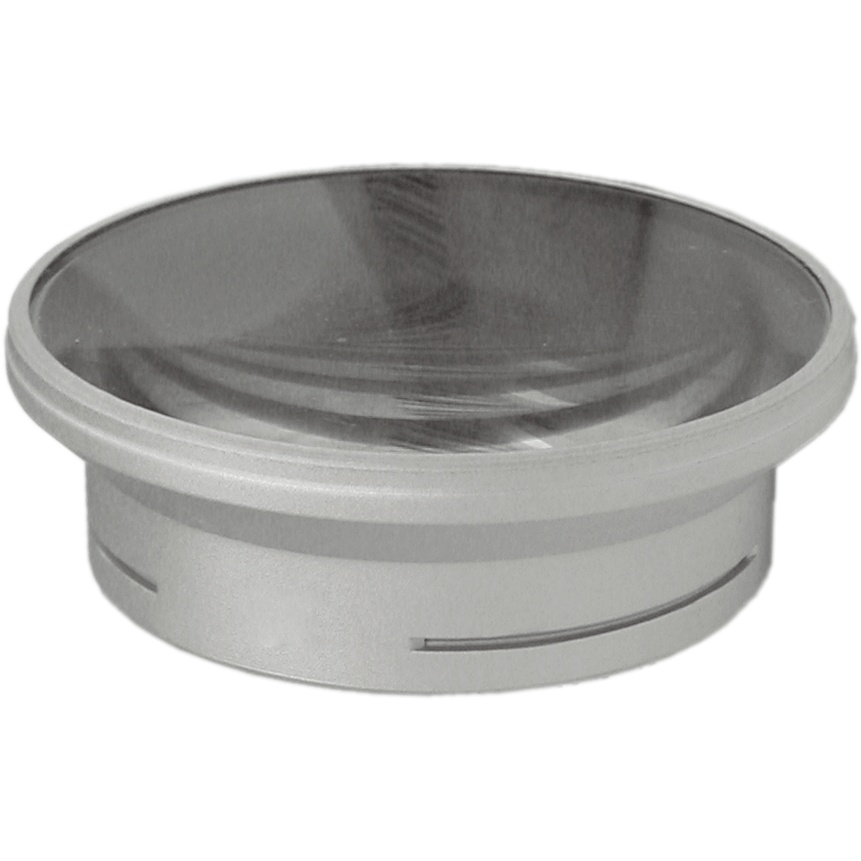
Reference:
BV20.A03

Mineral monocular add-on lens for near vision. |
How to proceed |
- You can:
- Buy a trial case with 3 monoculars that fit the optician's standard trial frame
- Rent a trial case, for a one-off sale.
Our add-on lens holder, used with its trial box, lets the optician find the wearer's optimal magnification.
- It is universal: all you need is one telescope with a trial ring.
- No more need for excessive stock.
- Placed on the trial frame, the patient's prescription can be added to assess the benefit with correction.
- The trial is done in real-life conditions.
- With a reading chart or a newspaper.
- On a computer screen.
- At intermediate distance, a television screen.
- To find the focal power of the add-on lens, divide 100 by the eye-to-object distance (in centimetres).
- Choose a large "panto" style frame.
- The optical centre must be the near-vision centre.
- The distance from the optical centre to the frame must be at least 19mm.
- Mark the optical centre (near vision) and check it.

- For a monocular fitting, order:
- The chosen 1.8x, 2.1x or 2.5x telescope (Code BV20.Gxx ?).
- The add-on lens determined with its trial box. Code (BV20.Axx ?)
- Option: pre-calibrated ophthalmic lens to be edged to 21mm.
- For a binocular fitting, order:
- 2 chosen 1.8x, 2.1x or 2.5x telescopes (Code BV20.Gxx ?).
- 2 add-on lenses determined with the trial box. Code (BV20.Axx ?)
- Option: 2 pre-calibrated ophthalmic lenses to be edged to 21mm.

- Or simply mark the near-vision optical centre on the spectacles and LESA FRANCE takes care of everything..............Code BV20.MONT
Simple, isn't it?........
Conversion table for removable add-on lenses |
|||||
|
Telescope magnification |
||||
|
1.8 x |
2.1 x |
2.5 x |
||
| 0.5 D | 2 metres | Watching television | 2.00 | 2.40 | 2.80 |
| 1 D | 1 metre | Watching television | 2.25 | 2.60 | 3.10 |
| 1.5 D | 66 centimetres | Looking at a screen | 2.50 | 2.90 | 3.40 |
| 2 D | 50 centimetres | Looking at a screen | 2.70 | 3.10 | 3.75 |
| 3 D | 33 centimetres | Looking at a screen, reading | 3.10 | 3.60 | 4.30 |
| 4 D | 25 centimetres | Looking at a screen, reading | 3.60 | 4.20 | 5.00 |
| 5 D | 25 centimetres | Looking at a screen, reading | 4.00 | 4.70 | 5.60 |
| 6 D | 17 centimetres | Looking at a screen, reading | 4.50 | 5.20 | 6.20 |
| 8 D | 12 centimetres | Looking at a screen, reading | 5.40 | 6.30 | 7.50 |
| 10 D | 10 centimetres | Looking at a screen, reading | 6.30 | 7.30 | 8.70 |
| 12 D | 8 centimetres | Looking at a screen, reading | 7.20 | 8.40 | 10.00 |
| 14 D | 7 centimetres | Looking at a screen, reading | 8.10 | 9.40 | 11.20 |
| 16 D | 6 centimetres | Looking at a screen, reading | 9.00 | 10.50 | 12.50 |
The Galilean telescope. |
| Telescopic systems are multi-lens systems that allow both distance and near vision. |
How does it work? |
Its basic principle is that of binoculars. |
Binoculars are a Keplerian system. |

|
The Galilean telescope is the most convincing alternative. |

|
Near vision. |
|
In summary. |
|
The big advantage. |
|
▲▲▲▲▲Back to top▲▲▲▲
Characteristics:
| Reference | BV20.A03 |
| Diopters | 3 D |
| Working distance | 330 mm |
| Net weight | 6 g |
| Material | Mineral glass |
| Public price (Tax incl.) | 135.39 € |