


Skip to Content
Reference: BV20.G16

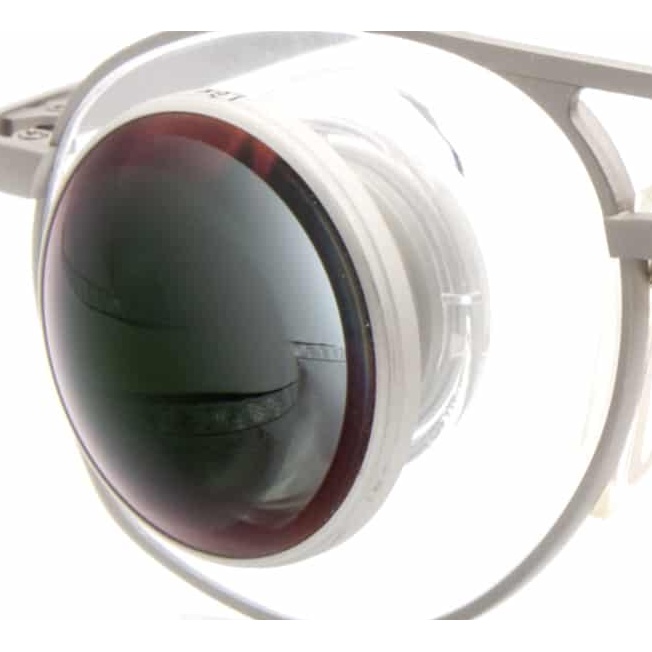
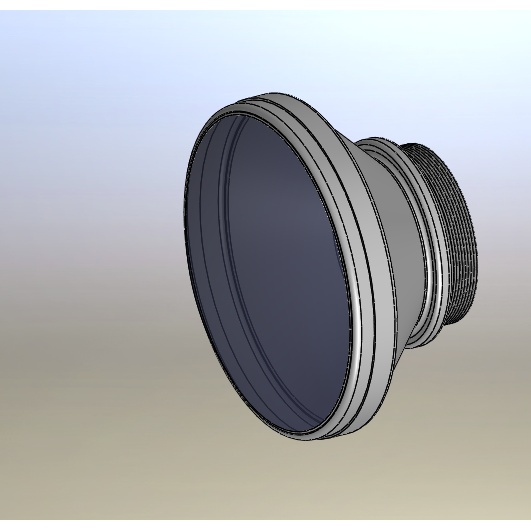
Galileo Monocular 1.6x Wide Field

Public price (Tax incl.) 457.16 €

General conditions
Delivery: 2-3 working days


Galilean system - Principle:


  • The Galilean monocular is an afocal magnifier, meaning the image is formed at infinity.
  • The point of this system is therefore simply to magnify for distance vision.
  • For near vision, simply add a flip-up close-up lens on the front.
  • Note: its power determines the working distance, which will be at the focal length.


Monocular:

  • Anodised aluminium body, very stable.
  • Very light (19 g) and compact.
  • Apochromatic telescope.
  • Wide field of view. 30° or 1100mm at 4m.
  • Anti-reflective coated.


The Galilean telescope.


Telescopic systems are multi-lens systems that allow both distance and near vision.


How does it work?

Its basic principle is the binocular.


Binoculars are a Keplerian system.

 
  • It consists of a convex objective and a concave eyepiece..
  • When the 2 focal points coincide, the system is said to be afocal.
  • The magnification of such a system is the ratio of the focal length of the objective to that of the eyepiece.
  • So imagine an objective of 80mm and an eyepiece of 40mm focal length: the magnification is 80/40=2.
  • The total length of the system is then 120mm, and the image is also inverted.
  • Rather difficult to mount on spectacles.

The Galilean telescope is the most convincing alternative.

  • It consists of a convex objective and a concave eyepiece.
  • When the 2 focal points coincide, the system is said to be afocal.
  • the 2 focal points coincide; since the eyepiece is negative, both lenses lie in front of the focal point.
  • The total length of the system is then 40mm, and the image is upright, so no erecting prisms are needed.
  • The drawback is that the eyepiece focal length is very high for a negative lens, which limits magnification to 3x at most to keep a correct image.
  • That said, the system is compact and light, so it can be mounted on an optical frame.

Near vision.

  • By adding a lens in front of a telescope, the focal length of the system becomes the focal length of the additional lens.
  • The magnification is the power of the telescope multiplied by that of the lens.
  • For binocular vision, the supports are mounted at an angle.
  • The limit of a binocular mounting is 5D.
  • To correct ametropia, a corrective lens is placed in front of the eyepiece.
  • We can carry out the complete mounting.

In summary.

  • The system is light and can be mounted on a frame.
  • A Galilean telescope without a lens gives vision at infinity for corrected ametropia
  • Near vision at the focal length of the additional lens.
  • Without corrected ametropia the image is correct; only the focal distance varies more or less.
  • Strong astigmatism must be corrected.
  • To correct ametropia, a corrective lens is placed in front of the eyepiece.
  • By design, our telescopes have a pinhole effect.

The big advantage.

  • Allows hands-free work.
  • Allows watching television with additions below 1.
  • Allows reading a whole screen simply by moving the head.

▲▲▲▲▲Back to top▲▲▲▲

Characteristics:

Reference BV20.G16
Commercial magnification 1.6 x
Net weight 11 g
Viewing angle 26 °
Public price (Tax incl.) 457.16 €