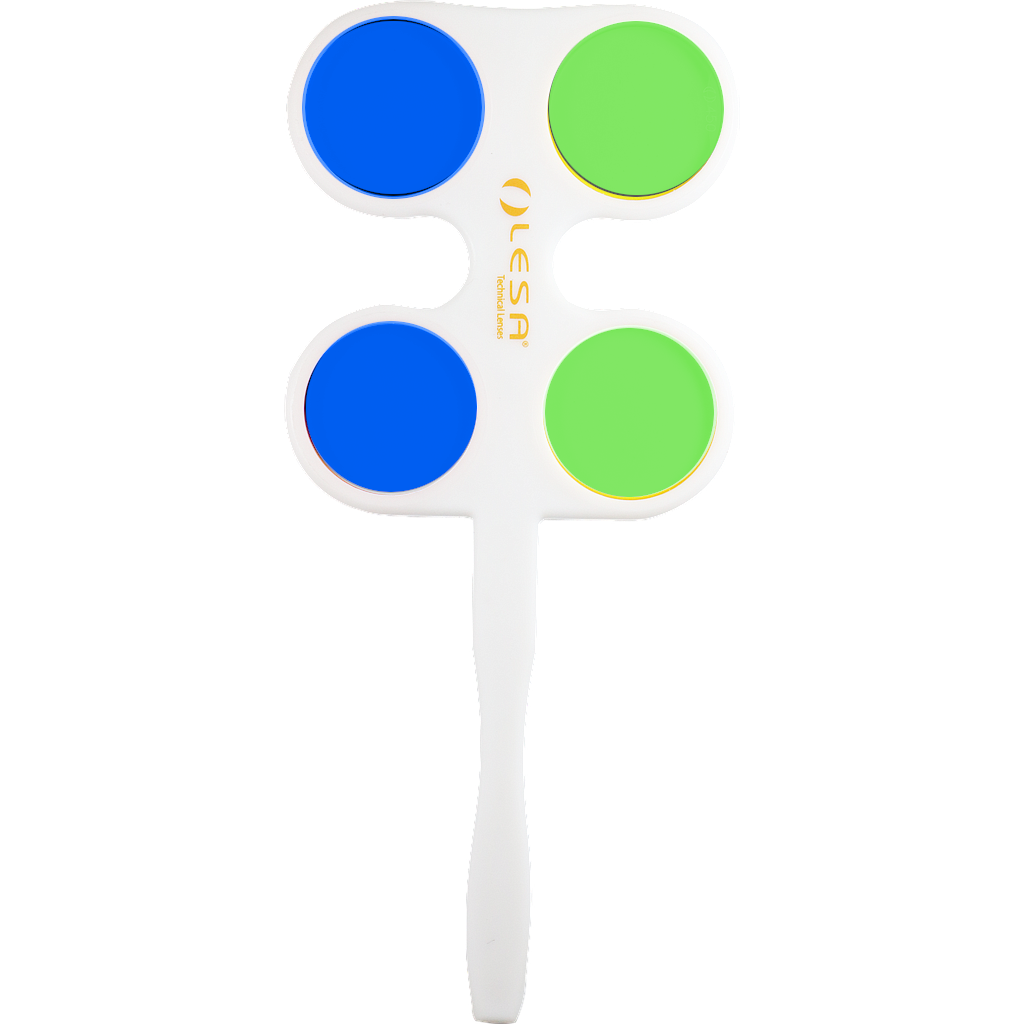
These lorgnettes let you quickly show your customers the benefits of therapeutic filters.
__________________________________________________________________________
On the website, to keep things simple, the lorgnettes are sorted by theme.
Filters from 3 pieces upwards are supplied in a case or small case.
The standard tints are described below.
All tints are engraved on the lens.
As a French optical manufacturer, we can supply tints on request. Please contact us.
The advantage of our filters is that they filter to a consistent spectrometric chart.
For daytime driving all filters are possible except, of course, category 4.
Depending on use, choose a suitable tint and category.
Take care not to select duplicates in the set.
Roughly 10 to 12% of the population cannot study or read properly because of light sensitivity problems.
Dyslexia is a complex problem because nobody knows exactly what causes it.
The "condition" ranges from reversing letters and numbers to an inability to understand (Irlen syndrome).
There is no standardised visual or medical performance test for this problem.
Schools have always wavered between the phonics method and the whole-word method for teaching reading, which sums up the problem.
In one case, reading is done sound by sound: very precise but slower, and requiring good vision.
The other method is whole-word and relies on memory, but can lead to random guesses when there are visual disorders.
On the optical side, what can we offer to improve comfort for people with dyslexia?
If the problem is visual:
Ametropia:
Poor focusing on the retina (myopia, hyperopia or astigmatism) forces a more or less tiring accommodation effort.
This is where the optician can really show their expertise.
Convergence:
A convergence defect is often the cause of accommodative asthenopia.
The optician can improve this with compensating prisms.
The orthoptist can provide eye exercises.
Dry eye syndrome:
Sensitivity to light, wind, cold, smoke, etc.
Eye strain.
The ophthalmologist can prescribe medication.
The optician can fit moisture chamber glasses, also known as "Google" over-glasses
Visual impairment:
This covers all visual pathologies that cannot be corrected.
The ophthalmologist, optician or orthoptist can offer:
A contrast-enhancing filter.
A filter to reduce eye strain.
A filter to reduce or correct the source of the disorder.
A magnifying ruler with a line guide to focus the eyes on one area.
Favour pinhole-type visual aids (reducing the visual field area and the diffraction spot).
If the problem is neurological:
The disorder can be reduced by cutting wavelengths close to red, which makes the image flatter and more restful.
How a filter works: a filter cuts wavelengths towards blue, towards red, or both. The colour of the filter is the average of the remaining rays (the integral of the curve).
Green "turquoise" tints are particularly useful because they preserve the circadian cycle as much as possible while cutting blues and reds.
Pink tints cut more blue and flatten the image perfectly while keeping good brightness.
Blue tints shift the spectrum towards blue and are best suited to more severe neurological problems.